Between Tenants and Thermostats: Closing the Accountability Gap That's Burning Out America's Rental HVAC Systems
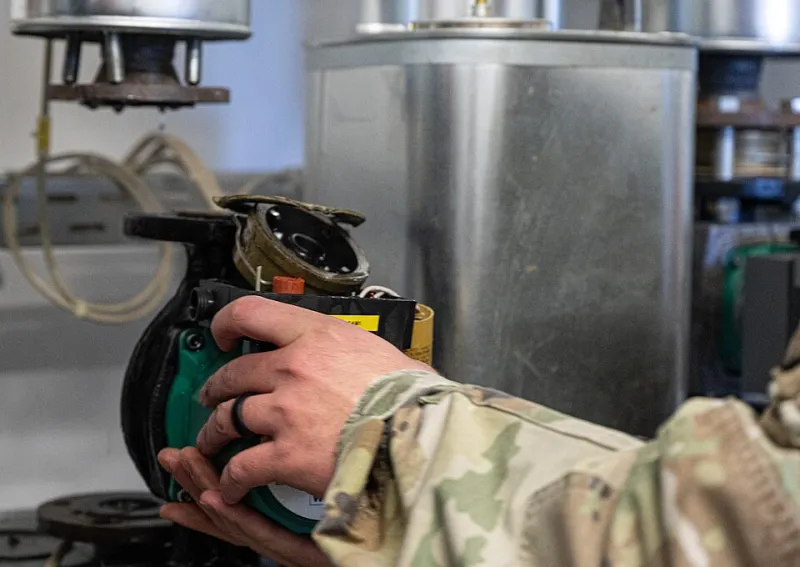
Photo: U.S. Air force photo by Senior Airman Thomas Karol, Public domain, via Wikimedia Commons
Ask any HVAC technician who works rental properties, and they will tell you the same thing: the worst-maintained filters in America are not in owner-occupied homes. They are in single-family rentals, duplexes, and small apartment buildings — places where nobody, quite literally, owns the problem.
The Accountability Vacuum
Filter neglect in rentals is not a character flaw; it is a structural problem. The tenant does not own the furnace, so the long-term consequences of a choked filter — a burned-out blower motor, a compressor working against starved airflow — land on someone else's balance sheet. The landlord, meanwhile, may live across town or across the country. If the rent arrives on time and no complaint is filed, the system is presumed healthy.
Neither party is negligent in the ordinary sense. Both are simply responding rationally to misaligned incentives. The tenant's incentive is to avoid hassle; the landlord's is to avoid capex. A $15 filter serves neither of those incentives directly — until the $6,000 system replacement invoice arrives, at which point both parties pay in some form: the landlord through capital expense and vacancy, the tenant through rent increases and discomfort.
What the Numbers Say
Consider a modest comparison drawn from typical Midwest and Sun Belt service rates:
- Annual filter budget for a single-family rental: 4 filters at $12–$20 each, roughly $50–$80 per year, plus 15 minutes of labor per change.
- Average cost of a blower motor replacement: $400–$900.
- Average cost of a compressor replacement: $1,500–$2,500.
- Full system replacement in a rental: $5,000–$8,500, frequently accelerated by years of restricted airflow.
The arithmetic is not close. A decade of diligent filter replacement costs less than a single major repair. Yet property surveys and technician anecdotes consistently show that a large share of rental filters are unchanged for a year or more — often discovered only when a system fails during a heat wave or cold snap, the worst possible timing for emergency pricing.
Lease Language That Actually Works
Vague clauses produce vague results. "Tenant shall maintain the premises in good condition" does not specify who buys the filter, who installs it, or what proof exists that it happened. Stronger lease provisions share three traits:
- Specificity. "Tenant shall replace the HVAC filter every 90 days with a filter of MERV 8–11, sized 20x25x1, provided by Landlord."
- Supply clarity. The most effective arrangements have the landlord supply filters in bulk — a case delivered at move-in — removing the tenant's cost excuse entirely.
- Documentation. A photo texted to the property manager upon replacement takes ten seconds and creates a timestamped record.
Some landlords resist paying for filters on principle. That principle is expensive. A $70 annual filter allowance is among the cheapest insurance available against five-figure capital events.
The Filter Log: A Property Manager's Cheapest Tool
Property managers overseeing even a handful of units can adopt a simple system:
- A spreadsheet or property-management app field recording filter size, MERV rating, and last-replaced date per unit.
- Calendar reminders set to 75–85 days, slightly ahead of the 90-day standard, to absorb delays.
- A case of filters per unit stored in the unit itself — utility room, closet shelf — so the replacement is never blocked by availability.
- Move-in and move-out filter changes as standard line items on the turnover checklist, so every tenancy begins with a known baseline.
Managers who implement this report a secondary benefit: the filter log becomes a diagnostic record. A tenant who never changes filters may also be a tenant who never reports a slow refrigerant leak or a failing capacitor. Filter compliance is a proxy for overall property communication.
Fixing the Gap Is a Two-Party Project
The rental filter problem will not be solved by assigning blame. It is solved by removing ambiguity: the lease names the responsible party, the landlord removes the cost barrier, the tenant removes the labor barrier, and the log removes the memory barrier. Every link in that chain costs less than one emergency service call.
Landlords who adopt the practice tend to discover what owner-occupants already know — that the filter is the least glamorous, most consequential component in the building. Every filter, every machine, every time. Rentals included.